Sermon — 8th Sunday of Luke (15 November 2026)
15 November 2026
Epistle — Ephesians 2:14-22
¹⁴ For he is our peace, who made both one, and broke down the middle wall of partition, ¹⁵ having abolished in his flesh the hostility, the law of commandments contained in ordinances, that he might create in himself one new man of the two, making peace; ¹⁶ and might reconcile them both in one body to God through the cross, having killed the hostility thereby. ¹⁷ He came and preached peace to you who were far off and to those who were near. ¹⁸ For through him we both have our access in one Spirit to the Father. ¹⁹ So then you are no longer strangers and foreigners, but you are fellow citizens with the saints, and of the household of God, ²⁰ being built on the foundation of the apostles and prophets, Christ Jesus himself being the chief cornerstone; ²¹ in whom the whole building, fitted together, grows into a holy temple in the Lord; ²² in whom you also are built together for a habitation of God in the Spirit.
Gospel — Luke 10:25-37
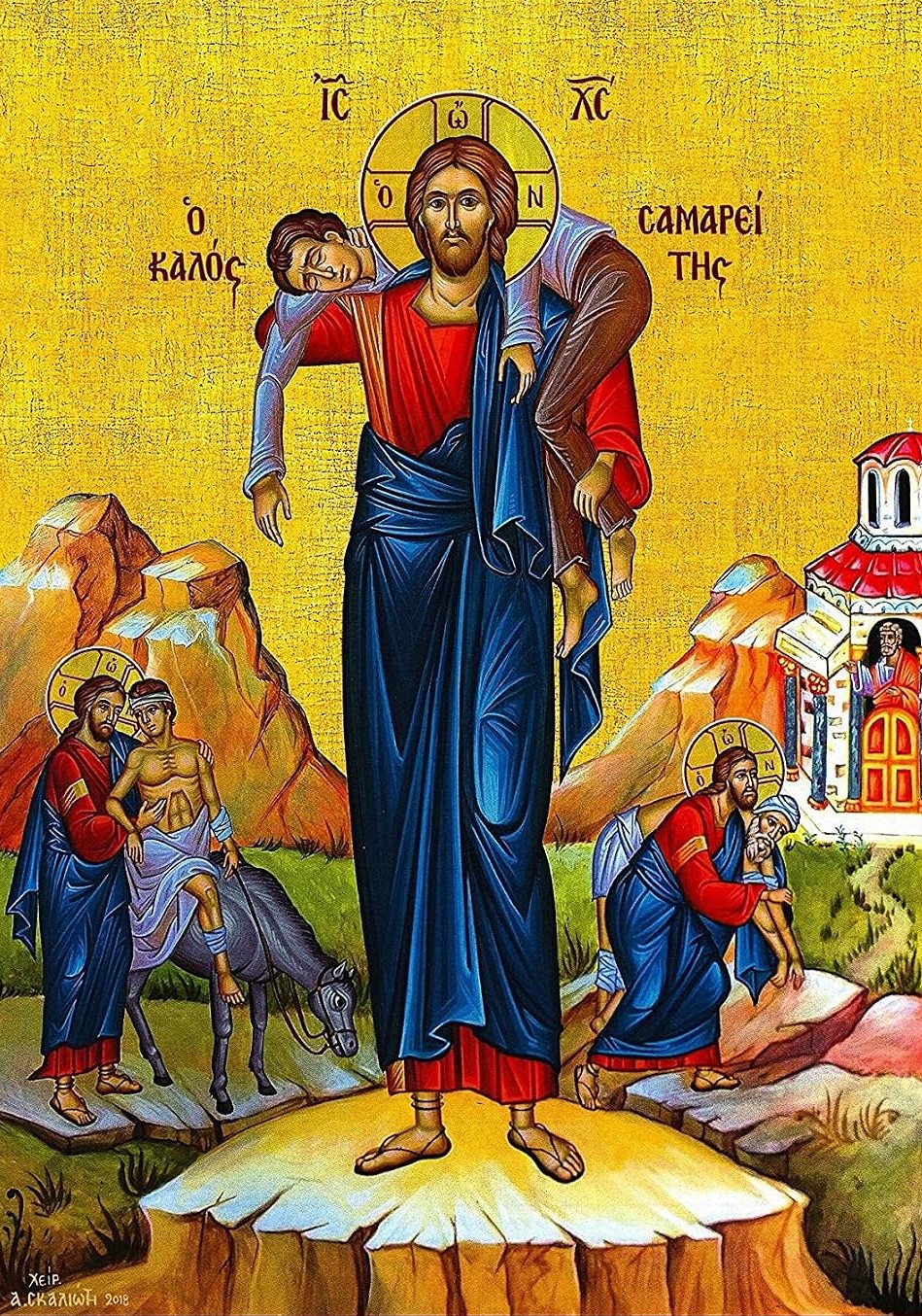
²⁵ Behold, a certain lawyer stood up and tested him, saying, "Teacher, what shall I do to inherit eternal life?" ²⁶ He said to him, "What is written in the law? How do you read it?" ²⁷ He answered, "You shall love the Lord your God with all your heart, with all your soul, with all your strength, and with all your mind; and your neighbor as yourself." ²⁸ He said to him, "You have answered correctly. Do this, and you will live." ²⁹ But he, desiring to justify himself, asked Jesus, "Who is my neighbor?" ³⁰ Jesus answered, "A certain man was going down from Jerusalem to Jericho, and he fell among robbers, who both stripped him and beat him, and departed, leaving him half dead. ³¹ By chance a certain priest was going down that way. When he saw him, he passed by on the other side. ³² In the same way a Levite also, when he came to the place, and saw him, passed by on the other side. ³³ But a certain Samaritan, as he traveled, came where he was. When he saw him, he was moved with compassion, ³⁴ came to him, and bound up his wounds, pouring on oil and wine. He set him on his own animal, and brought him to an inn, and took care of him. ³⁵ On the next day, when he departed, he took out two denarii, and gave them to the host, and said to him, 'Take care of him. Whatever you spend beyond that, I will repay you when I return.' ³⁶ Now which of these three do you think seemed to be a neighbor to him who fell among the robbers?" ³⁷ He said, "He who showed mercy on him." Then Jesus said to him, "Go and do likewise."
Sermon
Christ tells the story of a man of the Jewish nation who was rescued by a Samaritan, while two men who, like him, belonged to the people of Israel — a priest and a Levite — refused to help him. At that time the Jews did not yet fully understand that the Messiah had not come for them alone. He came to save the whole of mankind and to open the gates of His kingdom to all, without distinction of nationality, color, or sex.
"Who is my neighbor?" asks the lawyer. The answer is this: even the priest and the Levite who did not help him are neighbors to this man, but far more his neighbor is that foreigner, the Samaritan despised by the Jews, because he showed him mercy. From that time on, in Christ there is no longer any distinction between Greek and Jew, between Romans, between slave and free, between men and women. Christ is all, and in all (Col. 3:11).
The true worshiper of God is the one who acts mercifully toward his neighbor, whether of the same nationality or another. He loves everyone, because for him, just as for you, Christ brought His sacrifice of Golgotha on the Cross. By His precious blood we have all been set free from captivity to evil and received as participants in His banquet in the Kingdom.
On the road down from the heavenly Jerusalem we were set upon by robbers — demons — who beat us, stripped us of the robe of glory we had from God, and left us half dead by the road. Jesus Christ comes down to earth as the merciful Samaritan, to tend our wounds with oil and wine, to bind them up, and to entrust us to the innkeeper — that is, to His Church, which is the hospital of our souls and bodies. He promised that He would return at the end of the ages to establish His eternal kingdom.
Lord Jesus Christ, forgive us our malice and teach us to be merciful, just as You are merciful! Amen.