Sermon — 7th Sunday of Luke (8 November 2026)
8 November 2026
Epistle — Hebrews 2:2-10
² For if the word spoken through angels proved steadfast, and every transgression and disobedience received a just recompense; ³ how will we escape if we neglect so great a salvation—which at the first having been spoken through the Lord, was confirmed to us by those who heard; ⁴ God also testifying with them, both by signs and wonders, by various works of power, and by gifts of the Holy Spirit, according to his own will? ⁵ For he didn’t subject the world to come, of which we speak, to angels. ⁶ But one has somewhere testified, saying, “What is man, that you think of him? Or the son of man, that you care for him? ⁷ You made him a little lower than the angels. You crowned him with glory and honor. ⁸ You have put all things in subjection under his feet.” For in that he subjected all things to him, he left nothing that is not subject to him. But now we don’t see all things subjected to him, yet. ⁹ But we see him who has been made a little lower than the angels, Jesus, because of the suffering of death crowned with glory and honor, that by the grace of God he should taste of death for everyone. ¹⁰ For it became him, for whom are all things, and through whom are all things, in bringing many children to glory, to make the author of their salvation perfect through sufferings.
Gospel — Luke 8:41-56
⁴¹ Behold, there came a man named Jairus, and he was a ruler of the synagogue. He fell down at Jesus’ feet, and begged him to come into his house, ⁴² for he had an only daughter, about twelve years of age, and she was dying. But as he went, the multitudes pressed against him. ⁴³ A woman who had a flow of blood for twelve years, who had spent all her living on physicians, and could not be healed by any, ⁴⁴ came behind him, and touched the fringe of his cloak, and immediately the flow of her blood stopped. ⁴⁵ Jesus said, “Who touched me?” When all denied it, Peter and those with him said, “Master, the multitudes press and jostle you, and you say, ‘Who touched me?’” ⁴⁶ But Jesus said, “Someone did touch me, for I perceived that power has gone out of me.” ⁴⁷ When the woman saw that she was not hidden, she came trembling, and falling down before him declared to him in the presence of all the people the reason why she had touched him, and how she was healed immediately. ⁴⁸ He said to her, “Daughter, cheer up. Your faith has made you well. Go in peace.” ⁴⁹ While he still spoke, one from the ruler of the synagogue’s house came, saying to him, “Your daughter is dead. Don’t trouble the Teacher.” ⁵⁰ But Jesus hearing it, answered him, “Don’t be afraid. Only believe, and she will be healed.” ⁵¹ When he came to the house, he didn’t allow anyone to enter in, except Peter, John, James, the father of the child, and her mother. ⁵² All were weeping and mourning her, but he said, “Don’t weep. She isn’t dead, but sleeping.” ⁵³ They were ridiculing him, knowing that she was dead. ⁵⁴ But he put them all outside, and taking her by the hand, he called, saying, “Child, arise!” ⁵⁵ Her spirit returned, and she rose up immediately. He commanded that something be given to her to eat. ⁵⁶ Her parents were amazed, but he commanded them to tell no one what had been done.
"The Son of Man came to save what was lost" (Matthew 18:11). This is why He performs signs: casting out demons, healing the sick, and raising the dead. In this way He reveals His divine power and shows us that He does not want us to suffer, but to be healthy and happy.
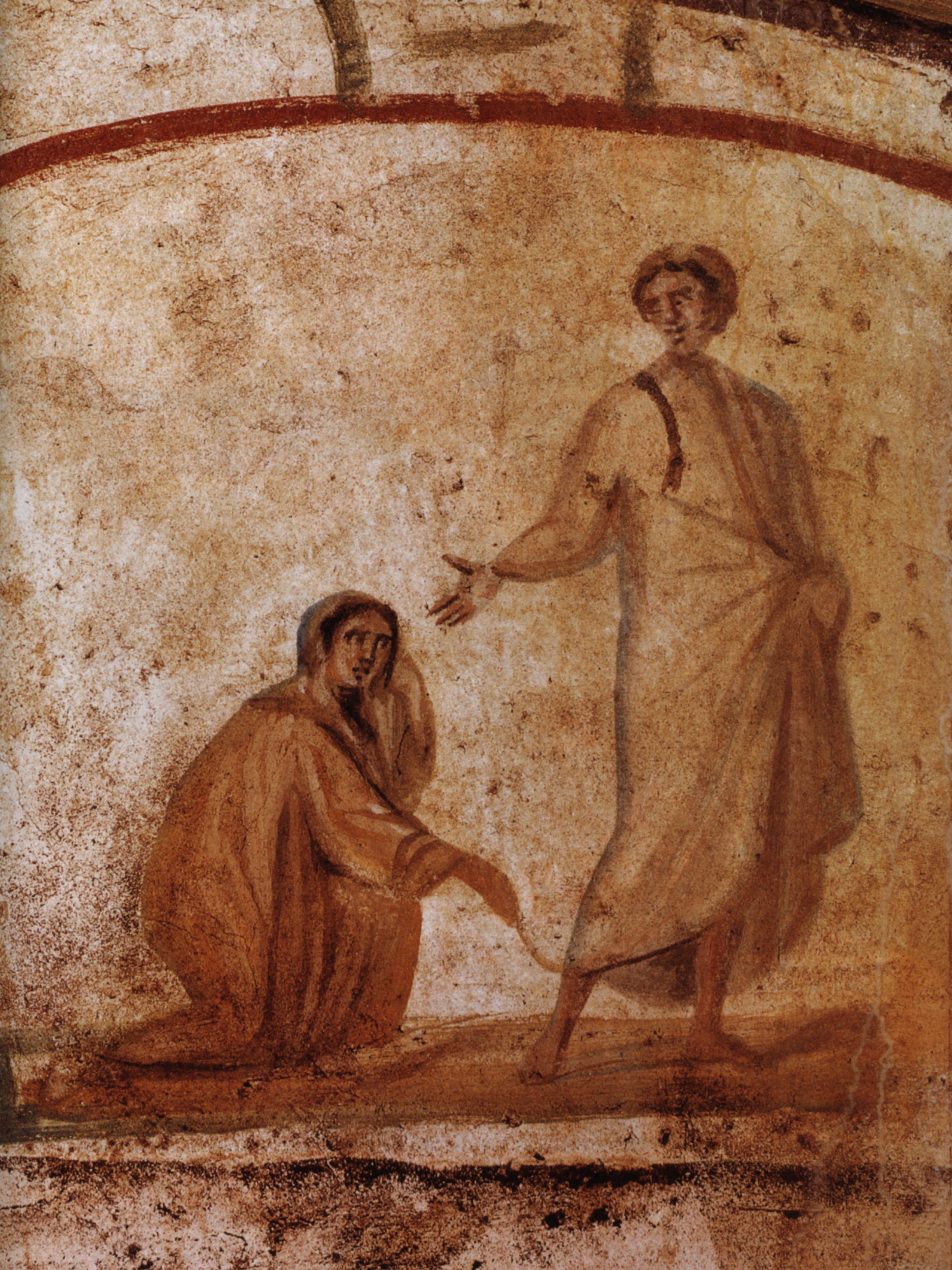
We know that the woman suffering from the flow of blood had been ill for twelve years. This illness not only wore her out physically, but tormented her even more in spirit. According to the Law of Moses she was considered ritually unclean and was not allowed to come near anyone — not even members of her own family, let alone strangers — lest she defile them with her impurity. In modern terms, she was effectively in a twelve-year quarantine, cut off from society.
She had spent her entire fortune on physicians, yet without any result. In the end she resolved on a desperate step, dangerous to her very life: zealous Jews could have stoned her on the spot for breaking the Law. Yet the moment she touched the hem of Jesus' garment, she knew at once that she had been healed.
Jesus called on her to confess before the whole crowd what she had done. The others were probably indignant, but Jesus encouraged her with the words: "Daughter, your faith has saved you. Go in peace."
This woman had broken the Law of Moses, but before her stood the One who came to replace the Law with grace: "The Law was given through Moses; grace and truth came through Jesus Christ" (John 1:17). It is true that the Law came from God. But it was given to people as "our guardian until Christ came, that we might be justified by faith. Now that faith has come, we are no longer under a guardian" (Galatians 3:24-25).
Jesus then performs the miracle of raising Jairus' twelve-year-old daughter. He does this in the presence of her parents, but also of His disciples Peter, John and James, because Scripture says: "Every matter must be established by the testimony of two or three witnesses" (cf. Deuteronomy 19:15).
And yet He commands them all not to speak of what had happened. Why? To teach us humility. We are not to seek our own vain glory, but to give all glory to God.
Both of these miracles happened through the faith of the people who asked Jesus for help. The woman was healed through her faith, and Jesus praised her for it: "Daughter, your faith has saved you." To Jairus He said: "Do not be afraid; only believe, and she will be saved."
It was precisely because of the unbelief of the people of His own town of Nazareth that Jesus did not work many miracles there. And in the same way He says to each of us: "Do not be afraid; only believe, pray, and I will save you."
Faith in the Lord Jesus Christ drives fear and every anxiety out of our hearts. Let us therefore believe! Just as He cleansed that woman of her impurity, He can cleanse us too, of the filth of our sins and passions. Only He can truly save us.
Jairus understood this well, even though he belonged to a class of religious leaders who were often hostile toward Jesus. Yet he knew that no one but Jesus could save his beloved daughter.
May Jesus Christ, our true God, save and heal each one of us by His divine power. Amen.